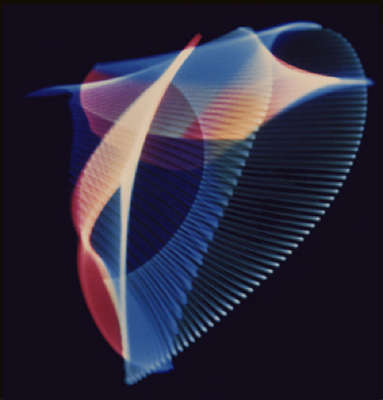
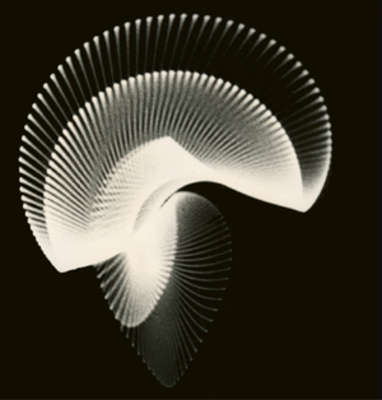
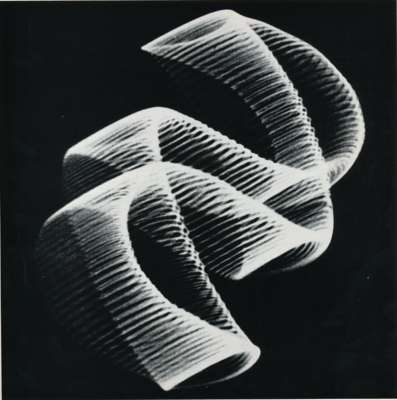
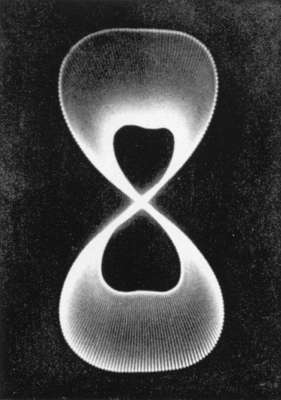
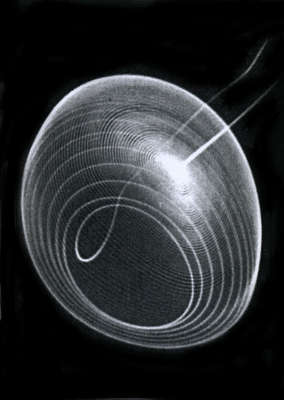
Ben F. Laposky was one of earliest computer art innovators, if not the first of all. It all depends on how you define your terms, what you consider to be “computer art”, and what you do not. Laposky generated images by using analogue electronic equipment in the early 1950s. In fact, he first demonstrated his “oscillons”, as he called them, in 1953. The name was to remind of the technical origin in oscilloscopes.
[An oscilloscope is an electronic instrument to measure and display properties of electronic signals. E.g., the amplitude, or the frequency, or other parameters of an electric signal varying over time can be displayed on the (usually small) screen of an oscilloscope. This is usually done for test purposes.]
Between 1942 and 1944, Laposky served in the US military at the post of a ‘Technical Sergeant’ working as a Map Draughtsman, till he was discharged because of injuries, with the Purple Heart medal.
He started his career in the arts as a draftsman at a signage shop he owned and providing ‘Magic Number Squares’ problems to the ’Rippley’s Believe it or Not!’ newspaper feature.
His training in mathematics and an article from a 1947 edition of ‘Popular Science’ which proposed the use of television testing equipment, such as oscilloscopes, to generate simple decorative patterns, based on a formula similar to that which governs pendulum curves, sparked his interst in geometric abstraction, algebraic curves etc. and led to experiments with an oscilloscope.
In 1950 Laposky used a cathode ray oscilloscope with sine wave generators and various other electrical and electronic circuits to create abstract art, refferd by himself as, “electrical compositions”. By tinkering with the electronic beams displayed by the oscilloscope’s cathode-ray tube and photographing them with usind a high-speed camera with color filters, the resulting images which he called ‘Oscillons’ displayed various aesthetic combinations of basic electronic wave forms playing a sort of ‘visual music’.
Laposky cited and admired Naum Gabo, Joan Miro, Piet Mondrian, Victor Vasarely, Kazimir Malevich, Fernand Léger, Marcel Duchamp, Alexander Calder and some of the Synchromism and Futurism artists.
These results were exhibited as photographs, kinetic oscilloscope displays, light boxes and movies starting with an exhiition in 1953 at the Sanford Museum, Iowa. This exhibition entitled ‘Electronic Abstractions’, toured over 200 venues in USA and other places abroad by the Cultural Relations Section of the United States from 1953 to 1961.
“The relationship of the oscillons to computer art is that the basic waveforms are analogue curves, of the type used in analogue computer systems.” (Ben F. laposky)