

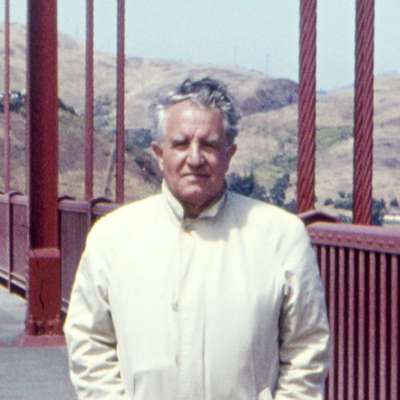


Max Bense was a German philosopher, scholar, and poet. His background studies were in philosophy, mathematics, geology, and physics, and later in information theory, semiotics, and cybernetics. He was particularly influential in the 1950s and 1960s in West-Germany and internationally. He became one of two founders of Information Aesthetics, the other one, with a slightly different approach, being Abraham A. Moles. At the occasion of the first exhibition of algorithmic art world-wide (then called “computer art”, on 5 February, 1965), he coined the term Generative Aesthetics.
Bense’s work on Information Aesthetics establishes the connection between him and the digital arts. In West-Germany in the 1950s, Bense also pioneered lectures and seminars on semiotics. In particular, he made students become aware of Charles Sanders Peirce’s view of semiotics, even before it became a more popular topic by the works of Umberto Eco.
Although he was already in the 1950s working on Information Aesthetics, his publications on aesthetic measures for works of fine art, literature, and music were met with some greater interest in Europe not before the 1960s. He introduced the term programming into aesthetics and art, so it cannot come as a surprise that the organizers of Tendencies 4 declared that Bense’s Information Aesthetics was “the theoretical basis of visual research using computers” [Herzogenrath et al., 2007]. Around the same time Bense became the leader of the Stuttgart school/group, which was an international place for semiotics and concrete poetry. It became known due to Bense’s own publications and those of Elisabeth Walther and many more of his collaboratos.
Arguably the most important contributions of Bense’s were his writings on Information Aesthetics. Being opposed to emotion-based value judgments, he considered any artifact as an object open for aesthetic analysis and mathematical evaluation. The aesthetic object was a complex sign that functioned in a process of communication. The Swiss artist of constructive concrete art, Max Bill, had an effect on Bense, whose inspiration on “modern aesthetics” Bense explicitly acknowledged in the preface of his Aesthetica II – Aesthetische Information, one of his five volumes series of Aesthetica. When Bill was rector of the celebrated Hochschule für Gestaltung in Ulm (Germany), he hired Bense to teach information which Bill believed to be important for post-war design and art.
Bense had a great impact on computer-generated art (algorithmic art) by exhibiting works of Georg Nees at his “Ästhetisches Colloquium” [Colloquy on Aesthetics], as early as February 1965, and of Frieder Nake at the Buchladen und Galerie Niedlich. The first of these shows was the first ever of computer art. Bense also suggested to Jasia Reichardt that she should start the endeavor that became the first encompassing spectacle of computer art Cybernetic Serendipity (August to October, 1968). He was the faculty advisor for the first Ph.D. in computer art by Georg Nees, and had a strong influence on the Computer Techniques Group in Japan, as well as on Frieder Nake, and others.
At the occasion of Bense’s hundredth birthday (2010), Ludwig Harig wrote in ZEIT online that Bense was considered to be the enfant terrible of his time in West Germany. Working for an open society, Bense attacked the metaphysical cozyness (Gemütlichkeit) of Germans.
Bense was always in opposition to established powers and institutions, often polemicizing against them. Experiment was his central form of creating art, music and text. Titles of his experimental poetic books were, e.g., Die präzisen Vergnügen (Precise delights), Die Zerstörung des Durstes durch Wasser (Destroying thirst by water), Das graue Rot der Poesie (The grey red of poetry).