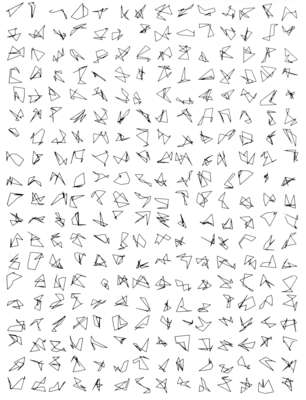
Georg Nees

Georg Nees was arguably the first world-wide to show his digital art. In all likelihood, his solo show at the Studiengalerie of Technische Hochschule Stuttgart (now University of Stuttgart) was the first ever that presented algorithmic drawings generated by a digital computer under program control. This show took place from February 5 to 19, 1965. For this occasion, one of the earliest publications on computer art appeared (“rot 19”, Stuttgart 1965). Max Bense contributed to it, projekte generativer ästhetik. Nees himself presented short technical notes on his drawings.
Georg Nees is one of the so-called “big three N’s” (the other two are A. Michael Noll and Frieder Nake. They all had shows of digital art in 1965).
Nees is a mathematician who has worked most of his career for the Siemens AG in Erlangen (Germany). He gained a doctoral degree in philosophy from the University of Stuttgart in 1968. The work was published as a book in 1969 (Generative Computergrafik). This was probably the first doctoral thesis in computer art.
Nees has exhibited extensively and worldwide. He has a large publishing record on topics of computer art, aesthetics, semiotics, artificial intelligence, and more. He was an honorary professor in computer science at University of Erlangen-Nürnberg. Kunsthalle Bremen dedicated a retrospective exhibition to him in 2005.
From 19xx to 19xx, Nees studied mathematics, physics, and philosophy at the University of Erlangen. Employed by the Siemens AG there, he began work in the emerging field of computer graphics in 1964. The company had acquired an automatic drawing machine, the Zuse Graphomat Z64, and it was Nees’ job to …..
The Graphomat was a construction by Konrad Zuse, one of the inventors of the programmable digital computer. It was a flat-bed drawing machine equipped with the option of controlling up to four pens or other tools. It operated at a precision of 1/16 mm. The drawing head’s movements were caused by two spindles organized in orthogonal directions. The two motors driving the spindles were controlled by a punched paper tape. This tape was generated by a program running on a digital computer.
Nees became the first to exhibit what then was called computer art, computergrafik in German or, better, algorithmic art. He had the opportunity in 1964 to show some of his graphics to Helmar Frank, a former Ph.D. candidate of Max Bense’s and Abraham A. Moles’. These two professors were the founders of Information Aesthetics, an attempt to use the concept of statistical information (Claude E. Shannon and Warren Weaver) for the aesthetic evaluation of artifacts.
Helmar Frank was one of the editors of the interdisciplinary journal Grundlagenstudien aus Kybernetik und Geisteswissenschaften, which came out of Bense’s institute. He encouraged Nees to submit to the journal his graphics work as part of a scientific article. Nees did so, and his short paper, “Statistische Grafik”, became one of the earliest publications in computer graphics. The company had insisted on the word “art” not to appear in the context.
Bense further invited Nees to show his graphic works in his experimental gallery. The gallery was dedicated to concrete art (text and graphics, typography), and similar movements. Algorithmically generated drawings were the most natural and consequential continuation of what Bense’s generally radical rationalism called for.
At the occasion of the exhibition (opened on February 5, 1965, for two weeks), Bense and Nees published issue no. 19 of the series of brochures collectively known as rot. This small booklet became one of the first, if not the first, publication in the field of computer art. It contains several of the drawings Nees exhibited in the show, plus short but precise pseudo-code. Bense wrote a short text, Projekte generativer Ästhetik, that may now be considered the manifesto of computer art.
Among his many publications, the book Formel, Farbe, Form. Computerästhetik für Medien und Design (Springer Verlag 1995) is an outstanding one.
When Frieder Nake prepared for his first exhibition, in November 1965 at the Galerie Wendelin Niedlich in Stuttgart, the gallerist invited Bense to talk at the opening. Bense suggested that Nees should be included with his works.
In 1968, Georg Nees defended his doctoral thesis for a degree in philosophy with Bense as the supervisor. The thesis was published in October 1969 under the title Generative Computergraphik. This became arguably the very first doctoral degree about a topic in computer art.
In 1977, Nees became Honorary Professor for Applied Computer Science at the University of Erlangen/Nuremberg. He was teaching there until retirement in 19xx.
He was a scientific advisor to Semiosis, the Internationale Zeitschrift für Semiotik und Ästhetik.
Nees has participated in many of the large computer art exhibitions. He had a retrospective solo show at Kunsthalle Bremen from 23 August to 2 October, 2005 under the title, Georg Nees: Künstliche Kunst. Die Anfänge (Articial Art: the Beginnings). This was the second in the series of Archeology of Digital Art that Kunsthalle started with a Frieder Nake show in 2004/05. The Nees retrospective went to ZKM in Karlsruhe as Georg Nees – The Great Temptation. Early generative computer graphics (19 August to15 October, 2006).
Nees lives and works in Erlangen.

- Login or register to post comments